

Current War Situation in Ukraine
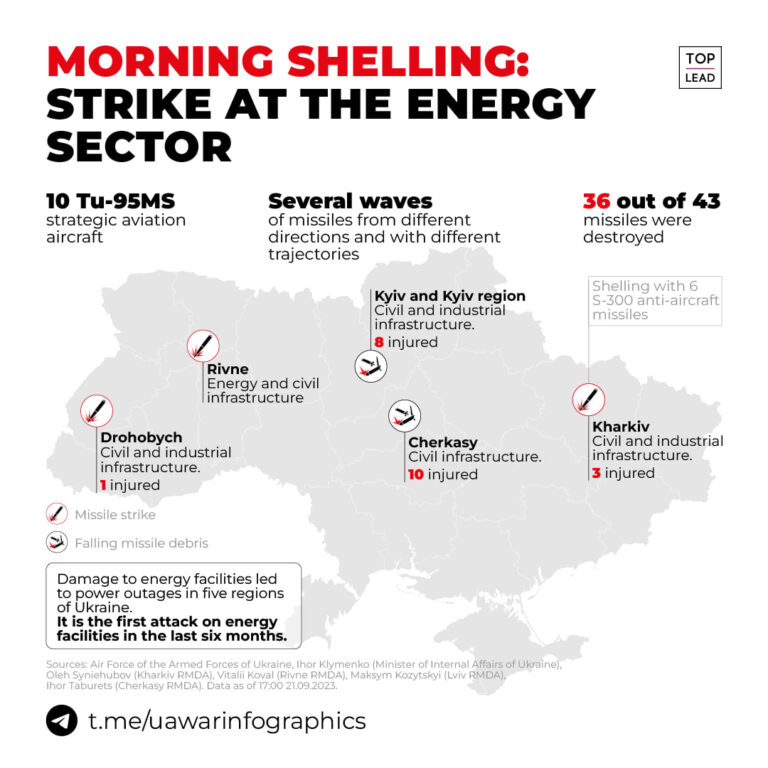
Attack on infrastructure. September 21, 2023
- russia shelled Ukraine’s energy infrastructure in Rivne. It is the first time after the brake of 6 months.
- During this attack, the PepsiCo plant in Vyshneve village (Kyiv oblast) suffered significant damage as a result of falling debris. A fire broke out on the territory of the enterprise.
- One person was killed.
Export. September, 2023.
Export 09.09 – 21.09:
- Sunflower exports decreased by 58% compared to last year.
- Production and export of sunflower oil increased by 25.4% and sunflower meal by 27.3%.
- About 1 mln tons of agricultural products were exported by river and sea transport in the first decade of September.
- Grain exports decreased by almost 3 mln tons due to russian attacks on ports.
- According to forecasts, in 2023/24, Ukraine will reduce wheat exports from 16.8 to 8-10 million tons compared to the current season (USDA estimates it at 10.5 million tons), which will amount to only 5% of the total grain exports in the 2022/23 season.
- On July 17, 2023, russia withdrew from the “grain agreement”.
- The occupiers began to regularly attack Ukrainian ports with missiles and drones.
- russian missiles hit the grain and oil terminals in Odesa.
- Since July, they have destroyed 280 K tons of grain stored in the southern regions.
"It becomes pointless for Ukrainian farmers to plant crops, because they simply lose money."
CEO of the Kernel company Yevhen Osypov.
- According to his forecasts, high costs will undermine grain production in Ukraine and lead to a reduction in exports in 2024 by half in comparison with last yearʼs level.
- The president of the Association of International Freight Forwarders, estimates that it costs about $116 to export a ton of grain to Egypt via the Danube, compared to about $69 before the russian invasion last year.
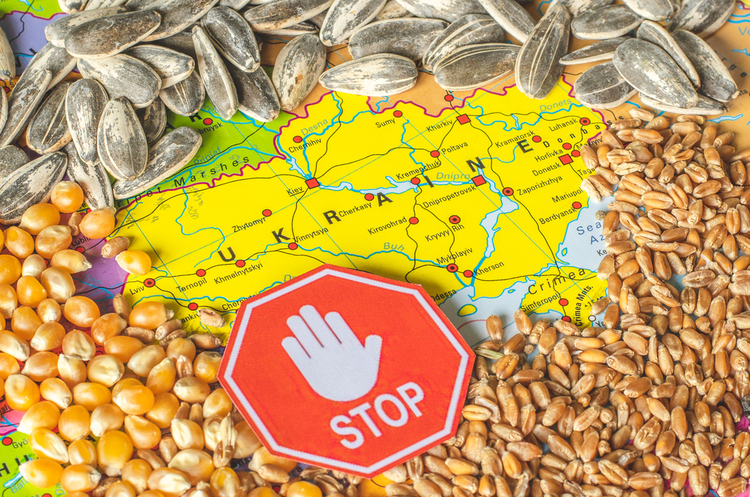
The ban on the import of Ukrainian agricultural products
September 15:
- European Commission canceled the ban on the import of Ukrainian wheat, corn, sunflower and rapeseed.
- Poland introduced a ban on exports, and expanded the list of products (+flour, bran, cake).
- Hungary introduced a national ban and expanded the list to 24 items.
- Slovakia introduced a ban.
- Romania did not continue the ban, but expects from Ukraine an Action Plan on export control of agricultural products.
September 14:
- Bulgaria supported the lifting of the import ban.
- As a result, farmers’ strikes began in Bulgaria.
- Croatia stated that it will not import Ukrainian grain and will also consider introducing an import ban following the example of Poland, Hungary and Slovakia.
September 18:
- Ukraine will sue Poland, Hungary and Slovakia for refusing to lift the ban on the import of Ukrainian agricultural products (Deputy Minister of Economy and Trade Representative of Ukraine Taras Kachka).
September 19:
- WTO confirmed that they received a complaint from Ukraine regarding the ban on the import of agricultural products.
- Ukraine said that if Poland and Hungary do not cancel the embargo, the Government will ban the import of specific categories of products from these countries (vegetables and fruits).
September 21:
- Poland, Romania and Bulgaria are ready to consider mechanisms of joint control of grain supply proposed by Ukraine.
- Romania and Bulgaria reacted positively and didn’t introduce national bans.
- Poland reported its readiness to work on solving the problem.
Planting season
As of September 11, 2023
Farmers in all oblasts of Ukraine planted 1.155 mln hectares of winter crops.
Ministry of Agrarian Policy and Food of Ukraine
905,900 ha of winter rapeseed and 249,000 ha of winter crops have already been planted (228,600 ha – wheat, 10,800 ha – barley and 9,500 ha – rye).
Harvesting
Farmers of Ukraine have finished harvesting winter grains and spring grains and legumes. They collected 37.4 mln tons of new harvest (as of September 22, 2023).
29,8 K tons of grain were harvested:
- wheat: 22,190 K tons;
- barley: 5,862 K tons;
- peas: 396.8 K tons;
- corn: 182,5 K tons;
- buckwheat: 138.2 K tons;
- millet: 125.3 K tons;
- other grain and leguminous crops: 905 K tons.
Farmers collected 7,649 K tons of oil crops:
- rapeseed: 4003 K tons;
- sunflower: 375 K tons;
- soybeans: 1 271 K tons.
Poltava oblast is the leader in harvesting sunflower (443.6 K tons) and soybeans (316.2 K tons), Odesa Oblast is the leader in harvesting rapeseed (436.9 K tons).
Harvesting of sugar beets continues – 1,460 K tons.
Lviv oblast is the leader in beet collection (118.7 K tons).